




If you've been shopping for a basketball hoop, you've probably run into the term "commercial grade" and wondered what it actually means. Does it mean it's only for schools and parks? Does it cost more? Is it even worth it for a home driveway?
Here's the short answer: commercial grade refers to the build quality, not just where the hoop ends up. And if you're investing in a hoop for your backyard or driveway, those same standards are exactly what you should be looking for.
Key Takeaways:
- In-ground basketball hoops are cemented into concrete, giving them far more stability than portable options
- Commercial-grade hoops use 7-gauge steel poles, 1/2-inch tempered glass, and breakaway rims
- A regulation commercial backboard measures 72 inches x 42 inches
- Professional installation costs around $499 and includes anchoring and full setup
- The PROview® 672 is the closest residential hoop to true commercial-grade specs
What Makes a Basketball Hoop "Commercial Grade"?
Commercial grade means the hoop is built to handle high-traffic use, various weather conditions, and the kind of play you'd see at a school, park, or community court.
These are the specs that separate a commercial basketball hoop from a standard residential one:
- Pole: Single-piece square steel post, typically 6 inches square, thick enough to absorb impact without flexing
- Steel gauge: 7-gauge steel is the standard for commercial-level stability; thinner gauges like 11 are more common in residential hoops
- Pole coating: Hot-dipped galvanized steel holds up through freeze-thaw cycles and harsh weather better than electroplated zinc, and self-repairs minor surface scratches over time
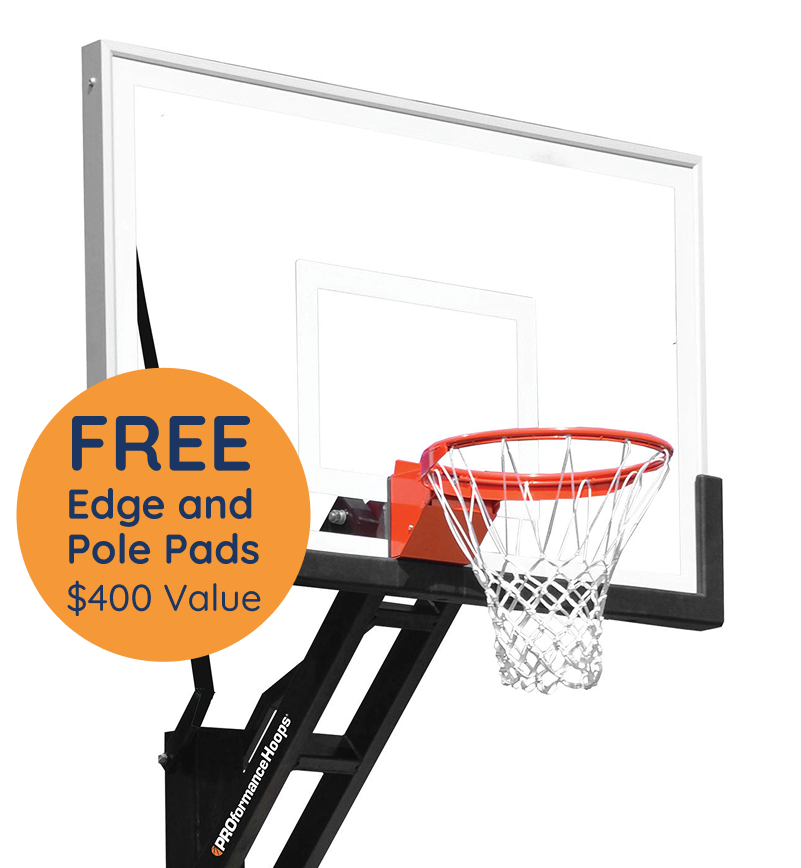
- Backboard: 72 inches x 42 inches with a flat transparent surface is the regulation size for competitive play
- Glass thickness: 1/2-inch tempered glass for authentic rebound performance; 3/8-inch is common in mid-range residential hoops
- Rim: Breakaway rims are mandatory for commercial facilities because they prevent backboard damage during dunks
- Anchor system: In-ground systems require a permanent concrete foundation anchor for maximum stability
- Overhang: The distance from the pole to the front of the backboard should range from 4 to 6 feet for safe play
- Pole pad: Reduces injury risk during collisions, especially for younger players
- Warranty: A lifetime warranty is the commercial standard
According to the NBA's official equipment rules, the regulation backboard measures 6 feet wide by 3.5 feet tall with a flat transparent surface. That's the 72-inch x 42-inch standard used at every level of competitive play, from high school gyms to NBA arenas. Choosing a hoop built to that same spec, with the right pole gauge and anchor kit, is what separates a system that holds up for years from one that needs constant attention.
In-Ground vs. Portable: What's the Real Difference?
There are four main types of basketball hoops: in-ground, portable, wall-mounted hoops, and direct-burial. Most families end up deciding between the first two.
Portable hoops are easy to assemble and move around. Fill the base with water or sand, roll it into position, and you're set. The trade-off is stability. The base can shift during play, the rebound isn't consistent, and they're not built for dunking or aggressive play.
In-ground basketball hoops are cemented into concrete. The pole doesn't move, the backboard doesn't shake, and the feel is much closer to a real court. No tipping risk, no adjusting after every hard shot.
|
Factor |
In-Ground |
Portable |
|
Stability |
Cemented, zero movement |
Can shift or tip during play |
|
Rebound quality |
Consistent, court-like feel |
Affected by pole flex and base movement |
|
Durability |
Built for years of outdoor use |
Shorter lifespan in harsh weather |
|
Installation |
Requires hole, concrete, anchor kit |
Easy to assemble, no tools needed |
|
Risk of tipping |
None once cemented |
Yes, especially with kids around |
|
Best for |
Families, athletes, driveways |
Casual play, renters, temporary setups |
In-ground goals win on every performance metric. The only real advantage of a portable hoop is that you can move it. If that's not a concern for your location, in-ground is the stronger choice. Our best in-ground basketball hoops guide breaks down all six PROformance systems in detail.
Which In-Ground Basketball Hoop Is Best for Commercial Use?
Not all in-ground hoops are built the same. Within the PROformance lineup, three models stand out as the best options for anyone who wants commercial-grade performance. You can compare all options across our 72-inch basketball hoop systems collection.
PROview® 672: Commercial-Grade Performance for Your Driveway

The PROview® 672 is the top pick. It checks every commercial-grade box in the lineup.
The 72-inch x 42-inch backboard matches the regulation size used in competitive play. The 1/2-inch tempered glass gives you a rigid, consistent rebound the same way a school gym or professional court would. The pole is a 6-inch x 6-inch single-piece steel post built with 7-gauge steel, the thickest in the PROformance range. It's hot-dipped galvanized, which means it handles weather conditions far better than standard powder-coated or zinc-plated poles.
The Power Arc 90 Lift Assist makes height adjustment smooth and easy, covering 6 feet to 10 feet without tools. The 4-foot overhang at 10 feet puts it right in the commercial safe-play range. At 577 pounds once installed, it's not going anywhere.
Key Specs:
- Backboard: 72" x 42" | 1/2" tempered glass
- Pole: 6" x 6" | 7-gauge | hot-dipped galvanized
- Height range: 6 to 10 feet
- Overhang: 4 feet
- Rim: Dual spring breakaway
- Warranty: Lifetime
Best for: Serious athletes, families who play hard, and anyone who wants a new basketball goal that performs like the real thing in their driveway or backyard.
PROview® 660: Professional Build, Perfect Driveway Fit

The PROview® 660 is the most popular hoop in the lineup, and it earns that spot. It carries the same 7-gauge steel pole, the same hot-dipped galvanized coating, and the same 1/2-inch tempered glass as the 672. The difference is the backboard size: 60 inches x 38 inches instead of 72 inches.
That one difference makes it the better fit for most home driveways and backyards. The 60-inch board gives you plenty of room for shooting and dunking without needing a massive court to support it. The build quality, the glass standard, and the pole specs are identical to the 672.
If you want commercial-grade performance in a size that fits a two-car driveway, browse the 60-inch in-ground hoops to see available options.
Key specs:
- Backboard: 60" x 38" | 1/2" tempered glass
- Pole: 6" x 6" | 7-gauge | hot-dipped galvanized
- Height range: 6 to 10 feet
- Overhang: 3 feet
- Rim: Dual spring breakaway
- Warranty: Lifetime
Best for: Families, growing athletes, and anyone who wants a professional-grade basketball hoop that fits a standard driveway.
PROforce® 672: Regulation Size, Honest Price

The PROforce® 672 gives you the right backboard size for commercial-grade play: 72 inches x 42 inches with 3/8-inch tempered glass. Where it steps down from the PROview® is in the steel gauge: 11-gauge instead of 7, and electroplated zinc instead of hot-dipped galvanized.
It's still a strong, durable in-ground goal. The single-cylinder gearbox height adjustment runs smoothly, and the dual spring breakaway rim is the same standard across all three models. At 406 pounds installed, it's lighter than the PROview® 672 but still stable under normal play conditions.
If budget is a concern and you still want a 72-inch backboard, this is a good option that doesn't require you to compromise on backboard size or glass quality.
Key specs:
- Backboard: 72" x 42" | 3/8" tempered glass
- Pole: 6" x 6" | 11-gauge | electroplated zinc
- Height range: 7.5 to 10 feet
- Overhang: 3 feet
- Rim: Dual spring breakaway
- Warranty: Lifetime
Best for: Competitive players and households that want a 72-inch in-ground basketball goal without the premium price tag.
How Much Does It Cost to Install an In-Ground Basketball Hoop?
Installation is where a lot of buyers get surprised. The hoop itself is one cost. Getting it properly set in the ground is another.
For in-ground basketball hoops, installation involves digging a hole, placing the anchor kit, pouring concrete, and letting it cure before the pole and backboard go up. It's not a quick afternoon project. Our basketball hoop installation guide walks through what each step involves so you know what to expect before you book.
Recreations Outlet offers professional basketball hoop installation and delivery to homes across Ohio, Kentucky, and Indiana. The service covers the full process from digging and anchoring to concrete and final setup. A pole that isn't level or an anchor that isn't deep enough will affect the stability and performance of the whole system, so getting it done right the first time matters. Contact us and we will help you figure out the best next step.
Ready to Set Up Your Court? Here's What to Do Next

A commercial-grade basketball hoop in your driveway or backyard is one of those purchases that gets used constantly. It's not seasonal, it doesn't need much maintenance, and it holds up through years of games, practice sessions, and family fun.
The PROview® 672 is the top pick for anyone who wants the full commercial-grade experience at home. The PROview® 660 is the best seller for good reason. And if the 72-inch backboard is the priority and budget is a concern, the PROforce® 672 gets you there.
All three are available at Recreations Outlet. Visit Recreations Outlet in Columbus or Recreations Outlet in Cincinnati to see the full lineup in person. You can also browse and order online and add professional installation at checkout.